Around 960 AD
The beginning
It is widely believed that Edgar the Peaceful, great-grandson of Alfred the Great, founded the first school in Tamworth at around the same time as he built the church.


31 Lower Gungate
A journey through Tamworth’s educational heritage, from an early school to the shop that stands here today.
Centuries beneath our feet
The building occupied by Seams and Dreams has a rich history. Tamworth’s present grammar school opened in the nineteenth century, but its predecessor stood much closer to the town centre—on this very site.
What follows is the story of education, civic arguments, surviving architectural details and one famous former pupil whose legacy reaches far beyond Tamworth.
The timeline
It is widely believed that Edgar the Peaceful, great-grandson of Alfred the Great, founded the first school in Tamworth at around the same time as he built the church.
A reference to Schoolmasters Lane suggests that some form of established school was operating in Tamworth by this time.
Surviving documentation confirms that a grammar school existed during the reign of Edward VI, financed by the Crown through Stafford County.
In the year of the Spanish Armada, Queen Elizabeth I granted Tamworth a charter establishing a grammar school for local boys. The school stood in Lower Gungate—exactly where our building stands.
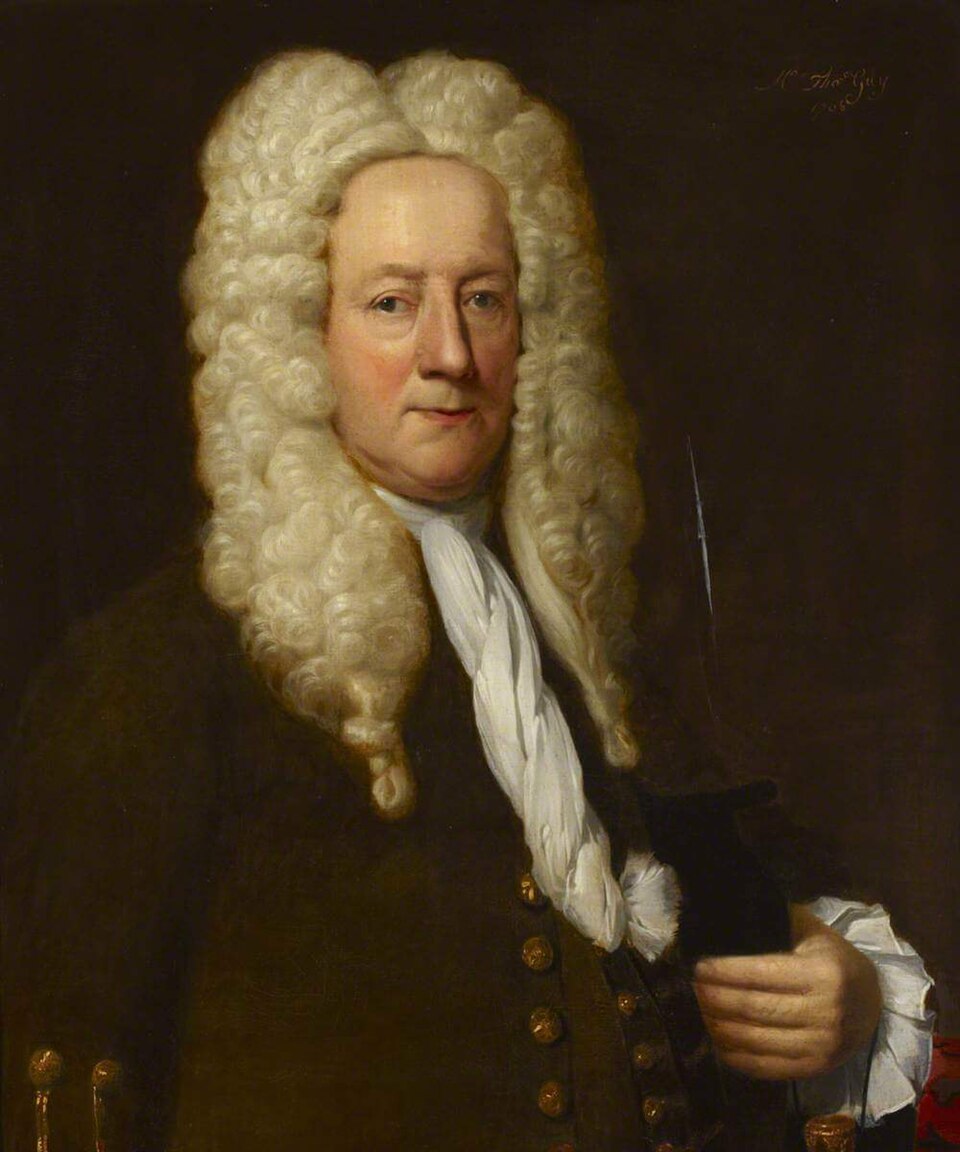
Thomas Guy was educated at the school on this site. He paid for its refurbishment in 1677 and also funded Tamworth’s Almshouses and Town Hall. He later financed Guy’s Hospital in Southwark and left his fortune to it.
After fierce disagreement about where a new school should be built, a site at the Swan’s Nest was selected. The new school opened in 1868, beginning a new era for boys’ education in Tamworth.
The original school was demolished for housing, but elements were incorporated into the lighter-coloured building visible today. Pillar tops and a plaster emblem from the earlier school survive in the frontage.
Stand outside Seams and Dreams and look slightly left at first-floor window-sill height. The surviving school emblem and related architectural details become visible across the building.
A famous former pupil
Born in Southwark, Thomas Guy came to Tamworth as a child after the death of his father. He was educated at the Free Grammar School on this site before returning to London as an apprentice bookbinder.
Success as a bookseller and publisher brought considerable wealth. His giving shaped Tamworth, but his greatest legacy was the hospital he personally financed in Southwark. Guy died before it opened in 1725 and was laid to rest there.
See it for yourself
Visit 31 Lower Gungate, opposite the Almshouses, and take a moment to look above the modern shopfront.